GripX Bench Guide
FINISHING TIPS
GripX works with the same belts and tools you already use. Main difference from G10 is the hardness — go light on pressure at the lower grits until you get a feel for it.
Every maker lands on their own preferred finish with this material, so the following is just a starting point.
Profile and shape like any other composite, then sand progressively through 120–220 grit. Hand sanding to 220 gives you a strong tactile finish and full grip performance - that's where I stop on most builds. You can push past 1000 grit if the build calls for it, but higher grit finish does trade some surface bite.
One thing worth knowing if you're working with black rubber (OG, Diamond, 3D): polishing can cause the rubber to burnish and smear. It's not a dealbreaker, just something to be aware of going in.
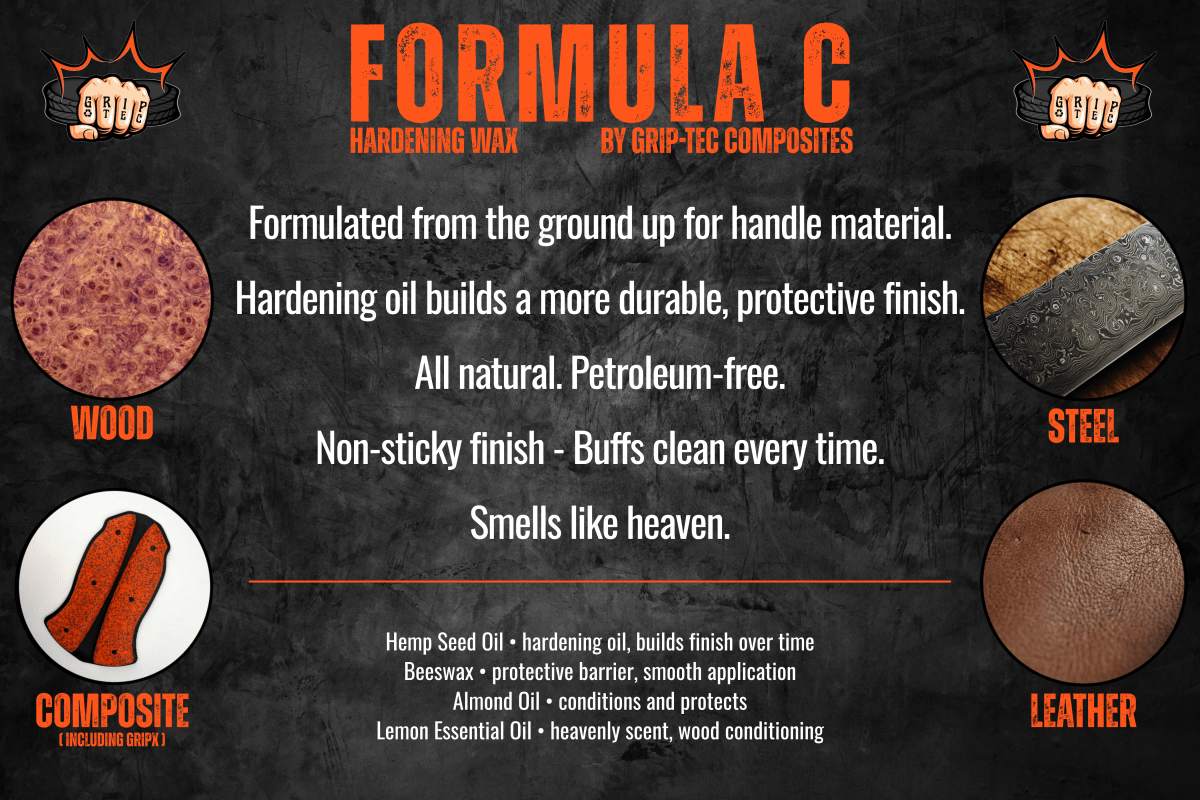
Once you're done, apply a light coat of RockWax Formula C and wipe it back off. The oils absorb into the rubber, swell it slightly, deepen the color, and bring the grip feel up a notch. Give it 24–48 hours before judging the finish — it can feel slightly slick right after application.
Diamond Edition: The mica starts showing its depth around 600 grit. Don't stop at 220 — that's where it gets interesting.
Limitless Edition: The colored rubber doesn't burnish like black, so you can take it to a full polish. Just know a high-gloss finish will marginally reduce surface bite.
GLUE RECOMMENDATIONS
GripX bonds like any other scale material. Thick CA or quality two-part epoxy both work well - thick CA is actually our preferred method (modern CA with proper prep is plenty durable for handle scales to liner).
Same process you already trust: clean surfaces, good prep, and solid clamp pressure. One thing worth noting with epoxy: the heat generated during cure can temporarily soften GripX, so avoid overclamping - a clean board wrapped in wax paper to spread clamping force out is a good call. Any indentations that show up will pop back out with mild heat. CA for GripX to liner, two-part epoxy from liner to tang — that's the combination we'd run on any full build.
STORAGE
Store GripX panels flat on a stable surface, away from direct heat and prolonged sun exposure. Like any resin-based composite, raw panels can see slight movement from long-term leaning or uneven heat — it's not a material flaw, just how resin behaves before it's glued up and pinned.
If minor warp ever occurs, heat evenly to around 150°F, clamp flat between two rigid surfaces with light even pressure, and let it cool fully. It'll come back flat.
WHAT TO EXPECT
As you work through the grits you'll start to feel the traction develop. That's the material doing what it's supposed to do. It's not flashy - it's functional, and the performance shows up when conditions aren't ideal and the handle stays locked in anyway.
If you post the build, tag @griptecofficial on IG and add us as a collaborator — we feature a maker every week and we'd genuinely love to see what you make.
Build something with bite.
If you ever have questions, just shoot us an email to matt@getgriptec.com. We stand behind the material and we're easy to reach.

RockSolid Scales
Formula C Hardening Wax


Diamond Edition GripX™
-
GripX™ - Bora Bora Blue - Diamond Edition
Regular price From $27.00Regular priceUnit price per -
GripX™ - Graphite - Diamond Edition
Regular price From $27.00Regular priceUnit price per -
GripX™ - Tuscan Yellow - Diamond Edition
Regular price From $27.00Regular priceUnit price per -
GripX™ - Olive Yellow - Diamond Edition
Regular price From $27.00Regular priceUnit price per -
GripX™ - Hazelnut Brown - Diamond Edition
Regular price From $27.00Regular priceUnit price per


Limitless Edition GripX™
-
GripX™ Limitless Edition - Shipwreck
Regular price From $37.00Regular priceUnit price per -
GripX™ Limitless Edition - Apex Hunter
Regular price From $30.00Regular priceUnit price per -
GripX™ Limitless Edition - Crimson Veil
Regular price From $30.00Regular priceUnit price per -
GripX™ Limitless Edition - Black Ice
Regular price From $30.00Regular priceUnit price per -
GripX™ Limitless Edition - Old Glory
Regular price From $36.00Regular priceUnit price per


